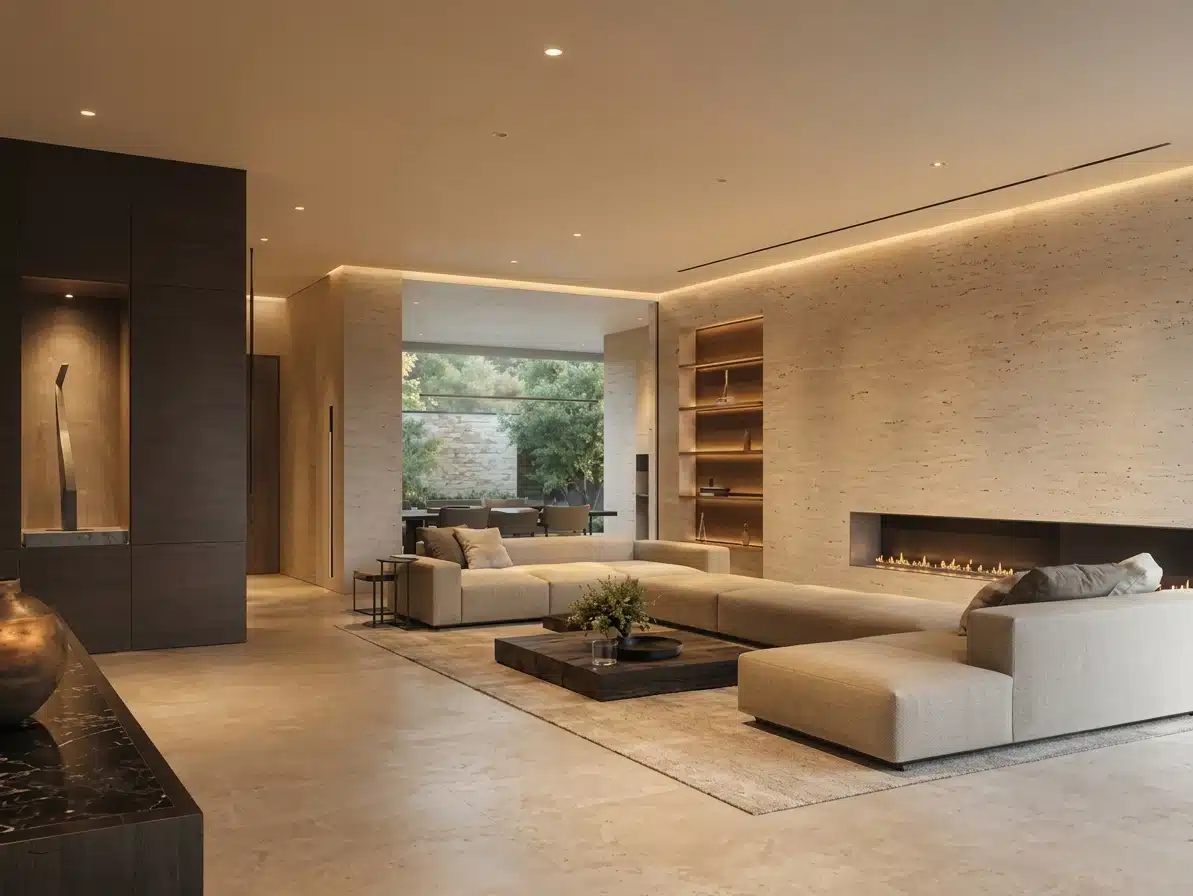
Integrated technology that remains unseen
The best home technology demands no attention. It ensures that lighting, climate control, audio, security, and energy systems perform exactly as residents expect, without the architecture being dominated by grilles, screens, and hardware.
In a high-end private residence, technology is not merely a collection of disparate products. Heating, cooling, ventilation, lighting, shading, audio, security, water, and energy systems share the same ceiling voids, service shafts, plant rooms, and digital infrastructure. When these disciplines only converge during the construction phase, visible compromises arise: dropped ceilings in the wrong places, oversized grilles, unsightly outdoor units, and control interfaces that differ from system to system.
Integrated engineering therefore begins alongside the architectural and interior design processes. For each room, parameters such as comfort levels, usage scenarios, internal heat loads, acoustics, lighting schemes, and control preferences are established. This is followed by capacity calculations, structural openings, routing, ceiling coordination, and technical space planning. Maintenance is also factored into the design: filters, valves, drivers, batteries, and equipment must remain accessible without requiring the dismantling of expensive custom-made features.
Moreover, luxury homes experience peak demands rarely seen in standard residences. Examples include the simultaneous use of multiple rain showers, a swimming pool, a sauna, a wine climate cabinet, EV charging stations, high-end kitchen appliances, and the cooling of large glass facades. Raw power alone is insufficient; control strategies, buffer capacities, and system priorities determine whether comfort is maintained during such peak loads.
Finally, high-quality technology requires clear ownership. A single integrated design, a unified functional specification, and a coordinated handover prevent suppliers from shifting blame to one another. The value lies not in incorporating as much technology as possible, but in a robust system that operates intuitively, runs quietly and efficiently, and allows for future maintenance or expansion.
In short
Invisible technology, palpable comfort