Back to overview
Ground-source heat pump or air-source heat pump: which suits an exclusive villa?
Blog - 9 October
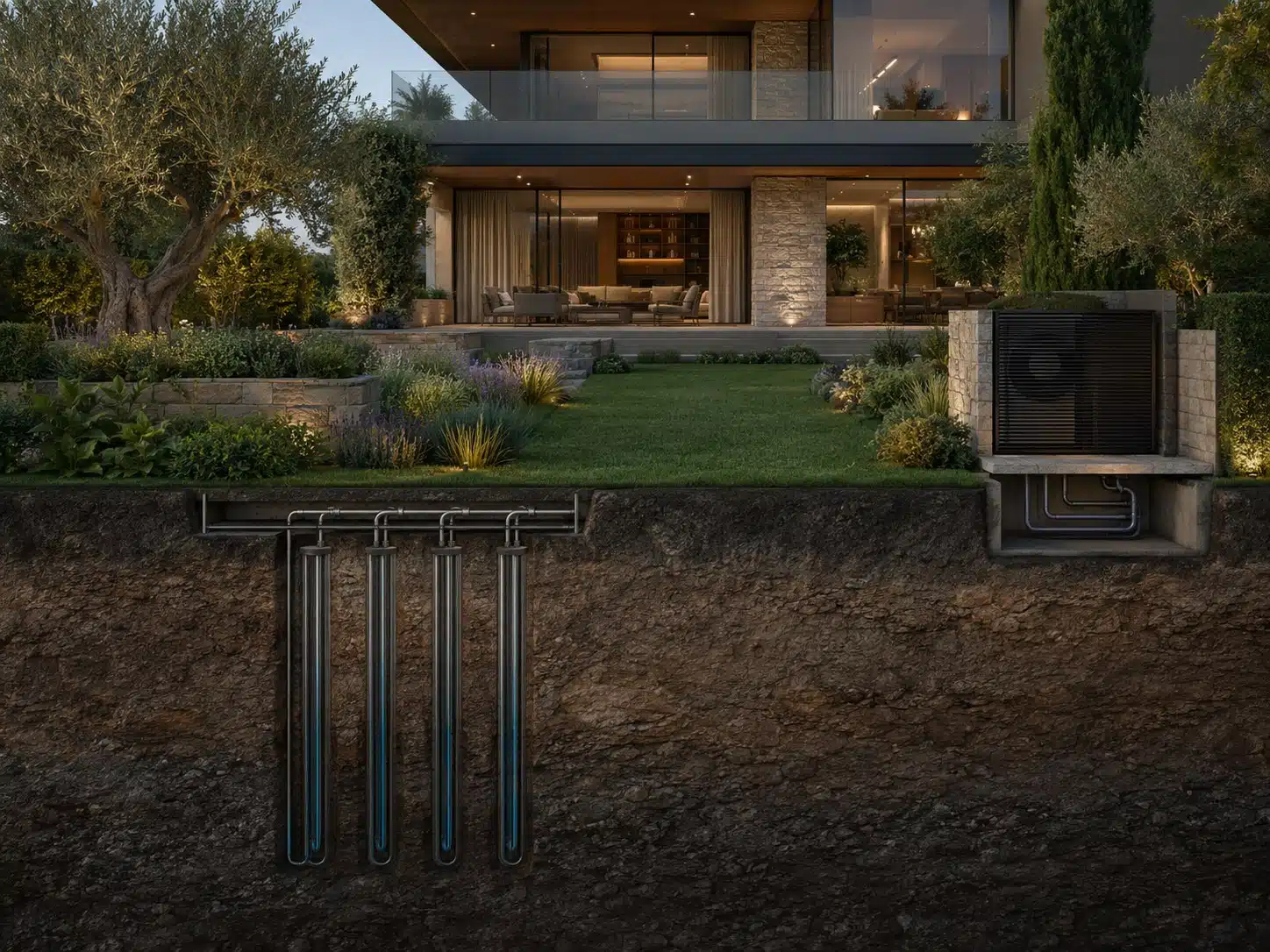
A ground-source heat pump—often referred to as ground-to-water or water-to-water—extracts heat from vertical ground loops or a suitable water source. The source temperature remains relatively stable throughout the year. This allows the system to heat efficiently and—depending on the design and permits—often provide highly energy-efficient passive cooling. Drawbacks include higher initial investment, the need for drilling, soil analysis, permits or notifications, and the requirement for careful source regeneration.
An air-to-water heat pump extracts energy from the outside air. The system is generally simpler and cheaper to install and is highly suitable when ground drilling is not possible or desirable. At low outdoor temperatures, efficiency drops and the outdoor unit has to work harder. Consequently, in high-end projects, factors such as noise, vibration, airflow, ice formation, condensate drainage, and visual integration are crucial design considerations.
Determining the better solution involves more than just the heat pump itself. A well-insulated home with underfloor heating or another low-temperature distribution system is advantageous. Large glass areas, wellness facilities, high domestic hot water demand, and active cooling requirements must also be factored into the calculations. The seasonal efficiency (SCOP) is a more meaningful metric than a single COP value measured under ideal test conditions.
For new builds with sufficient land and a long-term outlook, a ground-source system can be attractive due to its quiet operation, stable efficiency, and passive cooling capabilities. For renovations, an air-to-water system may offer a faster and less intrusive solution. The right choice is determined by a dynamic heating and cooling load calculation, a noise study, soil conditions, the electrical connection, and total life-cycle costs.
Do not compare purchase prices alone. Take a holistic view that includes the source, noise levels, cooling, domestic hot water, grid connection, maintenance, and service life.