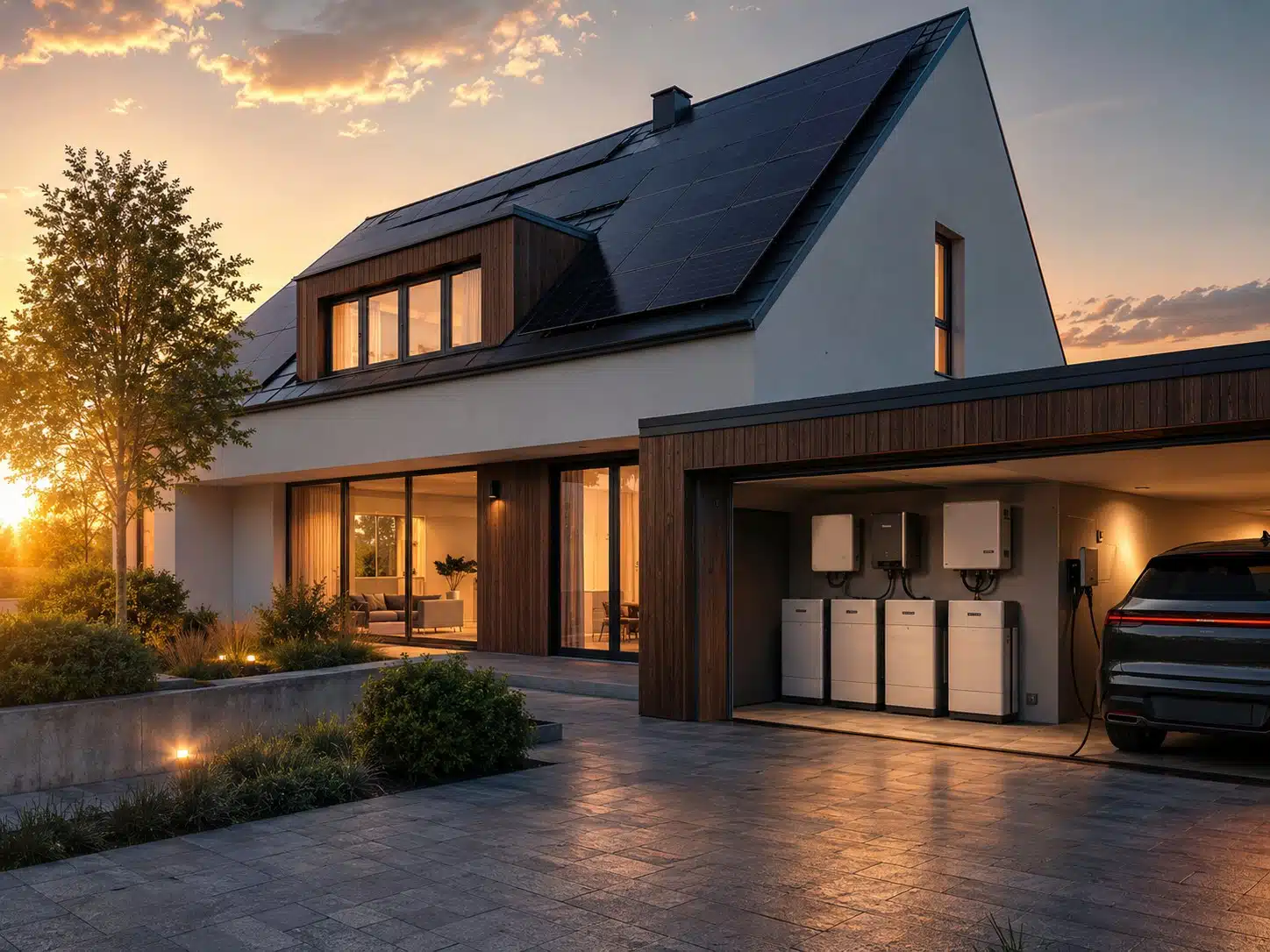
Solar panels and home battery: more self-generated energy, but not automatically off-grid
A large residence can generate a significant amount of solar power while also consuming a great deal of electricity. The challenge lies not merely in production, but primarily in the smart coordination of generation, storage, and consumption.
Solar panels significantly reduce CO₂ emissions compared to electricity from fossil fuel sources; however, their production and transport also carry a carbon footprint. Consequently, a home does not become literally “CO₂-free” simply by installing panels and a battery. Nevertheless, operational emissions can drop sharply—especially when heating, transport, and hot water systems are efficiently electrified and any remaining grid electricity is sourced from sustainable providers.
A home battery shifts solar power usage from the afternoon to the evening, thereby increasing self-consumption. According to Milieu Centraal, this self-consumption rate can roughly double from around thirty percent to sixty percent in a typical scenario. However, a battery cannot bridge seasonal gaps: summer often yields a surplus that exceeds storage capacity, whereas winter offers insufficient sunlight. Achieving complete grid independence requires a much larger, costlier system equipped with a backup power supply and, potentially, additional generation sources.
For high-end residences, an Energy Management System is essential. It can control charging stations, heat pumps, water heaters, swimming pools, and batteries—as well as manage dynamic tariffs—all within the limits of the grid connection’s capacity. This ensures that solar power is prioritized for immediate use and peak loads are minimized. It is important to explicitly verify which circuits remain powered during an outage; many standard battery systems do not provide backup power without additional equipment.
System sizing begins with an analysis of 15-minute or hourly data, projected future electricity consumption, and the desired level of autonomy. Battery capacity, measured in kWh, indicates the amount of energy stored; Inverter capacity in kW determines which loads can operate simultaneously. Fire safety, ventilation, placement, warranty, cycles, insurance, and a safe shutdown capability are all part of the design.