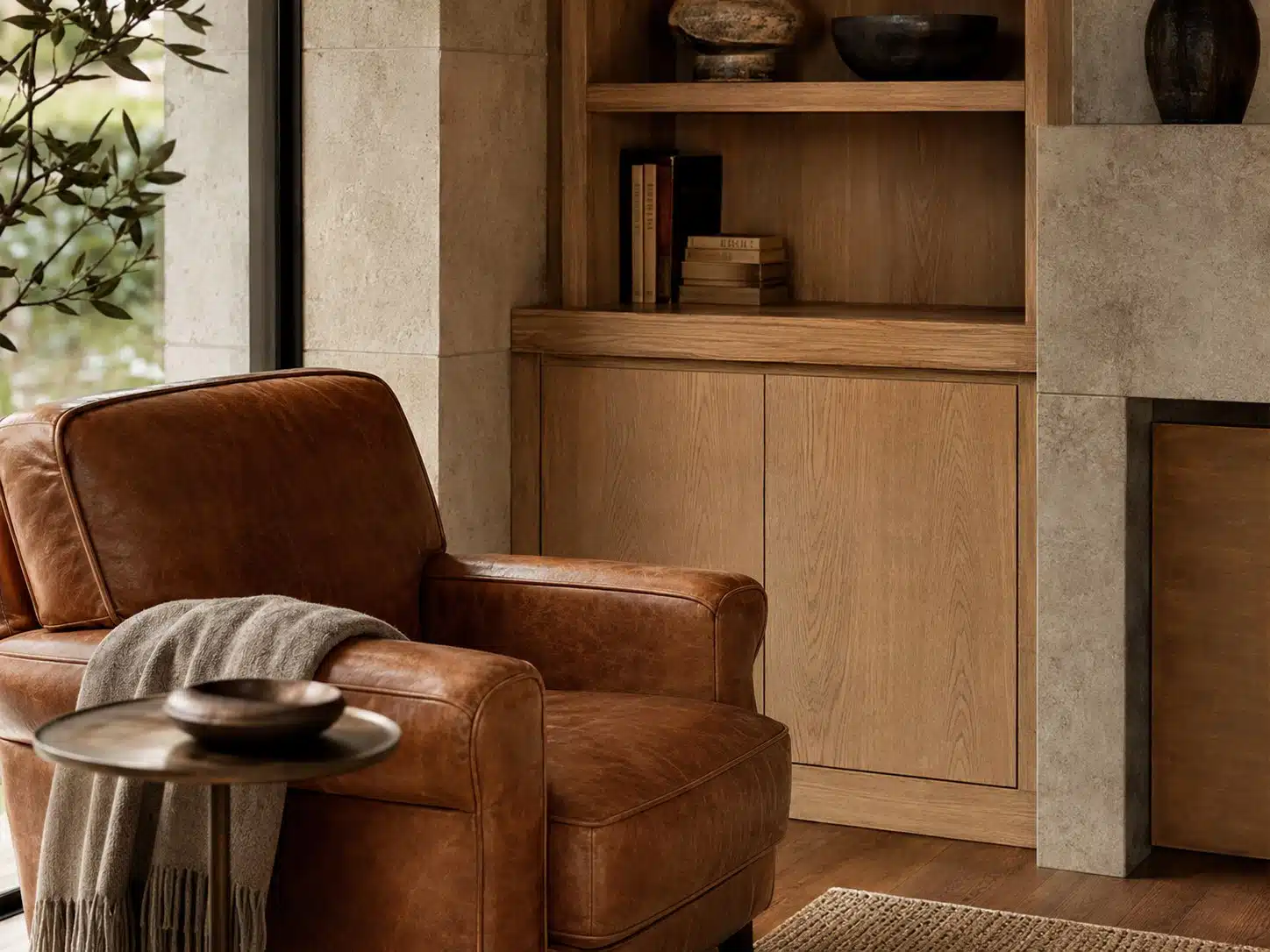
Sustainable materials become more beautiful over time.
Sustainability goes beyond a mere label. A material is truly valuable only when it is durable, easy to maintain, and remains impressive even after years of use.
Natural materials often have the ability to develop character. Bronze deepens in tone, leather acquires a subtle crease, wood softens in hue, and honed stone can absorb traces of use. This need not be seen as deterioration; a beautiful patina tells the story of a lived-in interior, provided the material and its application are well-matched.
Choosing sustainability requires a broader perspective. Origins, transport, and production are important, but so are technical lifespan, ease of disassembly, repairability, and replaceability. A timeless, custom-made front panel that can be refinished may be more sustainable than a trendy surface that requires complete replacement after just a few years.
That is why we discuss beforehand what kind of aging is acceptable—or even desirable. Anyone expecting a perfectly uniform surface might be better off choosing a material other than untreated brass or delicate natural stone. Honest advice prevents natural characteristics from later being perceived as flaws.
Proper maintenance is an integral part of the design. Using suitable cleaning agents, applying periodic oil or protective coatings, and keeping spare parts for vulnerable materials all extend the lifespan. Ultimately, the most sustainable form of luxury is an interior that acquires emotional value—because it is fitting, comfortable, and carefully designed, ensuring it does not need to be replaced anytime soon.
In short
Evaluate materials based on their entire lifecycle: origin, lifespan, maintenance, repair, aging, and future adaptability.