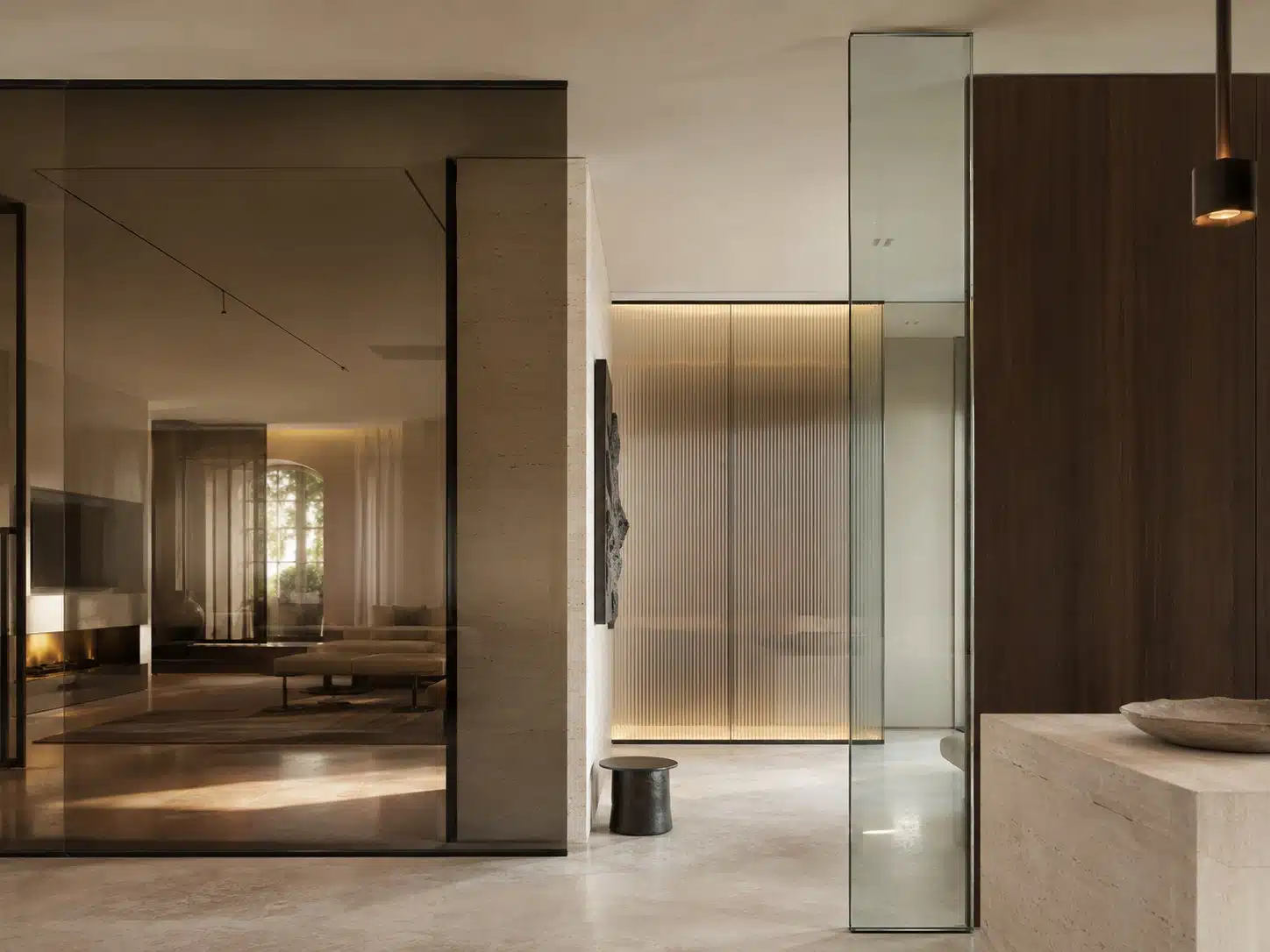
Glass in the interior designs with light.
Glass is never truly invisible. It reflects, filters, distorts, and frames. Precisely for this reason, it is a powerful material for connecting spaces without eliminating boundaries entirely.
Clear glass preserves sightlines and admits daylight while still providing acoustic and climatic separation. Smoked or bronze-tinted glass adds layers to a space and gives reflections greater depth. Ribbed, cast, or etched glass allows light to pass through while blurring details—ideal for situations where privacy is desired without creating a solid wall.
In a high-end interior, glass becomes part of the overall composition. The color of the glass must be harmonized with the metal, wood, and stone elements. Extra-clear glass prevents a green tint when paired with light-colored materials, whereas a warm hue can complement bronze and dark oak. Details such as edges, thickness, and mounting methods are also visible and deserve the same level of attention as the glass surface itself.
Lighting design requires experimentation. A line of light behind ribbed glass creates a different visual effect than direct frontal lighting. Dark glass surfaces may appear transparent during the day yet become reflective at night. Therefore, we evaluate glass not only using small samples but, whenever possible, through larger mock-ups and under varying lighting conditions.
Technical considerations remain inextricably linked to aesthetics. Factors such as safety ratings, laminated or tempered glass, deflection, acoustics, hardware, and tolerances determine what is feasible to execute. When these parameters are integrated from the outset, the result is a transparent architecture that is visually serene and functionally compelling.
In short
Glass design for both day and evening. Transparency, reflection, and privacy interplay with light and background.