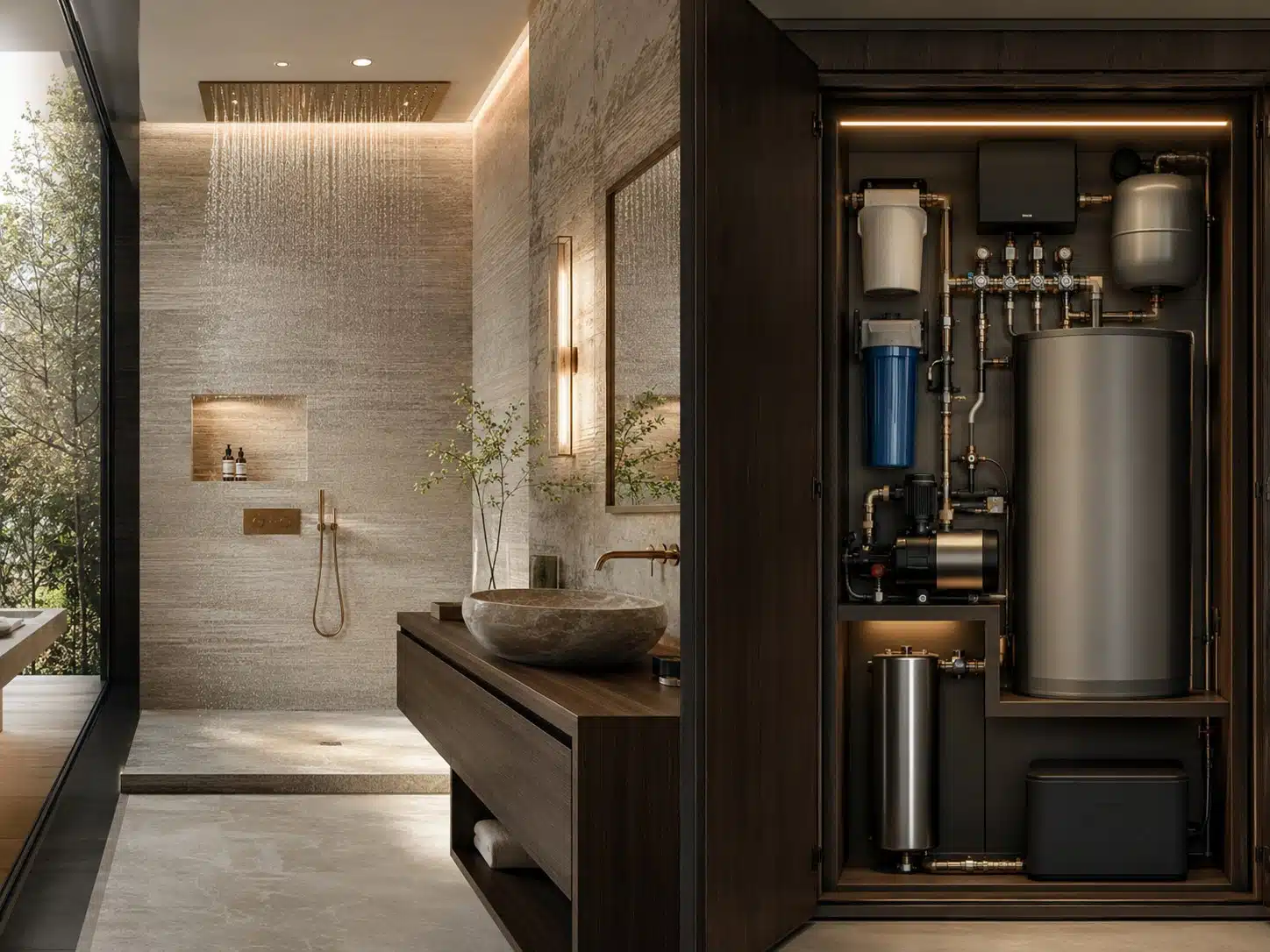
Home water comfort begins behind the wall.
A spacious rain shower, wellness bath, or outdoor kitchen seems like a given—until multiple outlets are used simultaneously. High-quality water comfort begins with calculations, zoning, and safety measures.
The design process starts with peak flow rates and available water pressure. Long pipe runs, elevation changes, and simultaneous usage can cause drops in pressure and temperature. A pressure-boosting system may be required, but it must be installed quietly, mounted to prevent vibration, and supplied with adequate inflow. Larger pipes are not automatically better; a balance must be struck between pipe volume, wait times, and hygiene.
Hot water requires a strategy regarding capacity and storage. A large heat pump water heater or storage tank can charge efficiently but takes up space and must be sized appropriately for the baths, showers, and user profile. A circulation system ensures quick hot water delivery but results in continuous heat loss if pipes are poorly insulated or run unnecessarily 24/7. Time-, presence-, or demand-controlled circulation can combine comfort with efficiency.
Water treatment depends on the location. A water softener can reduce limescale and protect equipment, but factors such as sizing, residual hardness, taste, maintenance, and discharge require careful consideration. Fine filters or specific drinking water filtration systems are selected based on measured water quality and the intended purpose; installing extra filters without a clear reason is not necessarily healthier.
Leak detection is essential for high-end interiors. Zone sensors in utility rooms, kitchens, bathrooms, and laundry areas can be combined with flow monitoring and an automatic main shut-off valve. The system must be capable of recognizing unusual nighttime consumption without falsely flagging pool systems, irrigation, or water treatment processes as leaks. Drainage, emergency overflows, and floor waterproofing also remain essential.
Swimming pools, spas, saunas, and hammams require specialized water, air, and dehumidification systems. Chlorine chemistry, ventilation, and corrosion resistance impact materials and installations in adjacent areas. By designing the “front-of-house” experience and “back-of-house” technical systems simultaneously, the wellness facility remains both spacious and easy to maintain.
In short
Calculate peak flow rate, pressure, hot water storage, and drainage. Combine comfort with insulation, demand-based control, maintenance access, and automatic leak shut-off.