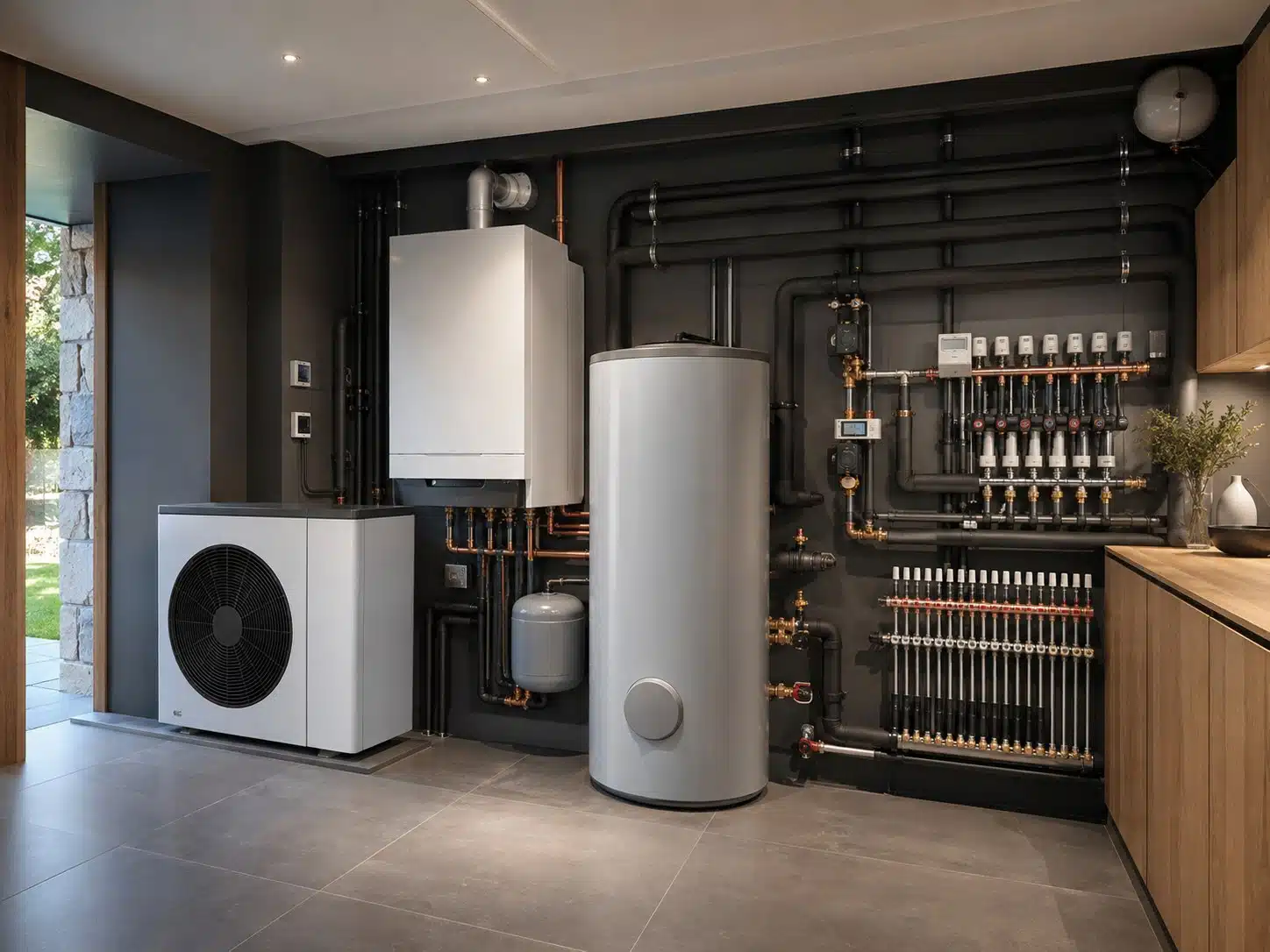
When a hybrid heat pump is smart
Not every existing villa can switch to an all-electric system in a single step.
A hybrid system can significantly reduce gas consumption, while the central heating boiler handles peak loads and domestic hot water production.
In a hybrid setup, the heat pump provides the base heating load for much of the year. The central heating boiler takes over or provides support during periods of extreme cold, when high water temperatures are required, or when the control system determines that doing so is more economically or technically advantageous. The exact switching logic varies by system and must be fine-tuned to the specific home and heat distribution system.
This approach is particularly viable for renovation projects involving existing radiators, high peak demand, or limited space for large hot water tanks. A prerequisite is that the home’s energy performance is improved as much as possible first: addressing air leaks, insulation, glazing, and hydronic balancing, as well as implementing low-temperature heat distribution where feasible. A heat pump cannot compensate for a poor building envelope.
The quality of the control strategy determines the level of savings achieved. Parameters such as the bivalent temperature, electricity and gas prices, flow temperature, and actual output capacity must be correctly configured. An oversized system cycles too frequently, while an undersized system leaves an unnecessary amount of the workload to the boiler. Monitoring during the first heating season reveals where further optimization is possible.
Hybrid systems remain partially reliant on fossil fuels as long as the boiler uses natural gas. While not a definitive solution for every home, it can serve as a deliberate intermediate step toward an all-electric system. Therefore, adopt a future-proof design approach: allocate sufficient electrical capacity, installation space, and buffer storage options so that any subsequent upgrade does not require another major renovation.
In short
Always combine a hybrid heat pump with improvements to the building envelope, an effective heat distribution system, proper hydraulic design, and seasonal monitoring.