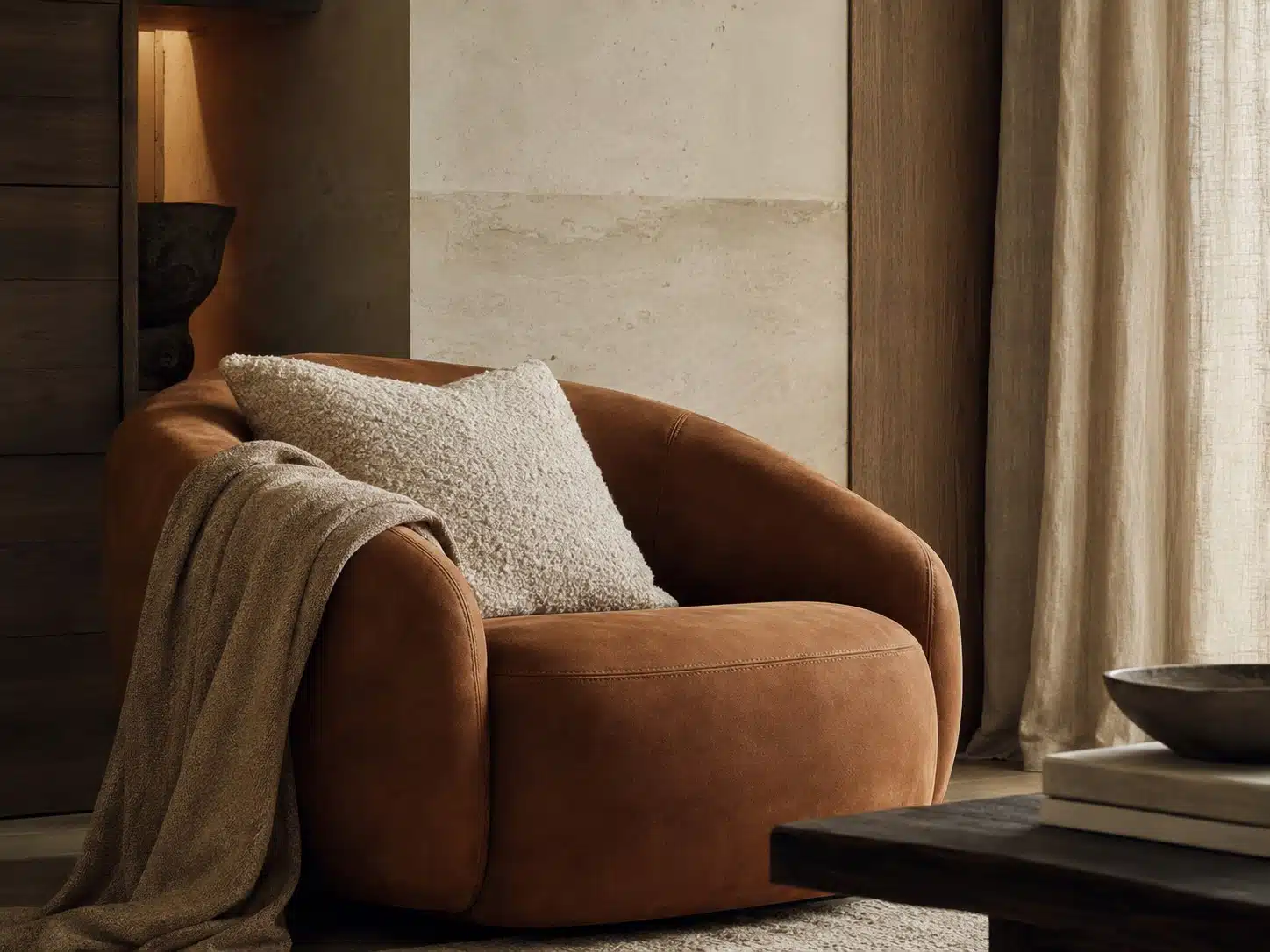
Leather and textiles make luxury tangible.
An interior can be visually perfect yet feel aloof. Leather and textiles introduce softness and acoustic comfort, inviting one to truly inhabit the space.
Tactility arises from contrast. We juxtapose stone, glass, and metal with materials that absorb light and feel pleasant to the touch. Nubuck leather offers a matte, velvety depth, while smooth leather accentuates form and stitching. Wool provides warmth and resilience; linen offers natural irregularity; and bouclé adds a distinctive yet soft texture.
The choice begins with application. An armchair requires different durability and stretch characteristics than a wall panel. Curtains must not only drape beautifully but also provide the desired level of transparency, blackout, and acoustic performance. A rug anchors furniture and dampens sound, while its pile height and texture can add a subtle, extra layer of interest.
Color gains richness through fiber and nap. The same taupe shade might appear calmly matte in wool, yet react more deeply to grazing light in nubuck. That is why we evaluate textiles both vertically and horizontally, under both natural and artificial light. Large samples are also crucial; a small swatch fails to adequately reveal pattern repeats, drape, and color effects.
True luxury lies in comfort that feels effortless. Seams follow the form, patterns align, and fabrics are selected with daily life in mind. Materials are meant to be used, but must be suited to the intensity of that use. In this way, softness becomes not merely a decorative element, but an integral part of the architecture.
In short
Select soft materials based on both feel and performance: abrasion resistance, lightfastness, drape, acoustics, maintenance, and aging.