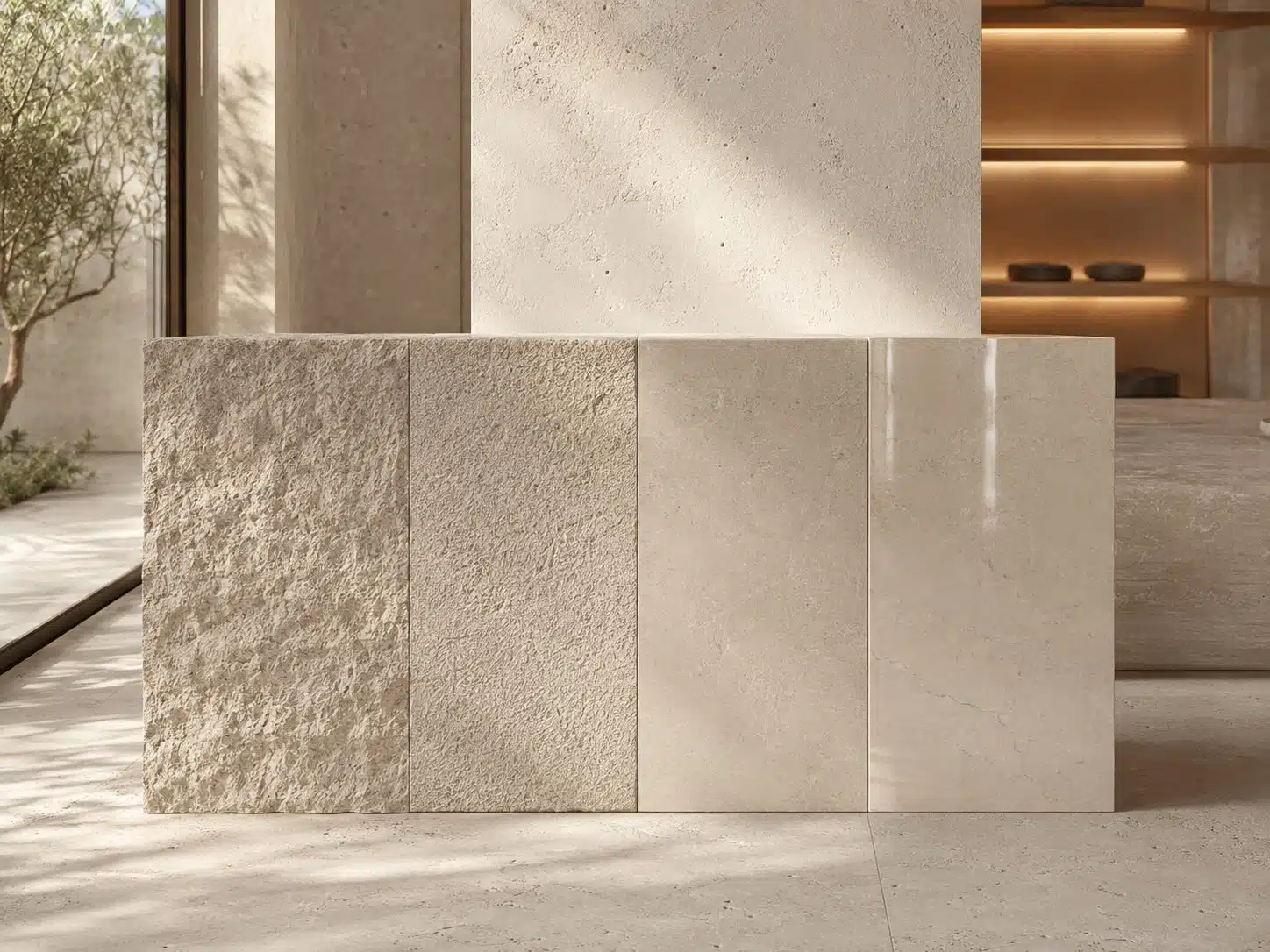
The finish of natural stone makes the difference.
No two slabs of natural stone are identical. It is precisely this natural variation that lends depth to an interior, yet the final aesthetic is determined just as strongly by the chosen finish.
The *World of Materials* preview showcases a wide spectrum of techniques: from coarse and fine sawing to bush-hammering, chiseling, rough-dressing, sanding, sandblasting, brushing, honing, and polishing. Each treatment alters how light interacts with the surface. Rough finishes give the stone a tactile, matte quality; honed surfaces reveal color and veining with a subtle sheen; polishing enhances contrast and reflectivity.
In high-end interiors, we always select the finish based on function and architecture. A coarser surface can lend a sense of mass to a monumental wall or fireplace. For a kitchen countertop or washbasin, a finely honed finish often offers a more serene and pleasant experience in daily use. A polished detail can look stunning when catching directional light, yet becomes even more striking when juxtaposed with a matte surface.
The direction of the cut is also a decisive factor. A “vein-cut” reveals the stone’s layering in linear patterns, whereas a “cross-cut” can create a cloudier, more tranquil appearance. With distinctive marbles, the layout across walls, floors, and bespoke elements requires careful orchestration: slabs are pre-selected, digitally mapped out, and mirrored where necessary. In this way, the stone’s natural patterning becomes an integral part of the architecture.
Natural stone also demands technical consideration—factors such as porosity, acid sensitivity, slip resistance, impregnation, slab thickness, and suitable substructures. A sample piece is indispensable; the same stone can look surprisingly different depending on the lighting and the chosen finish. The goal is not perfection devoid of nuance, but a controlled, natural look.
In short
Never select a type of stone in isolation. Also specify the sawing direction, slab layout, finish, edge detail, joint pattern, and protection.