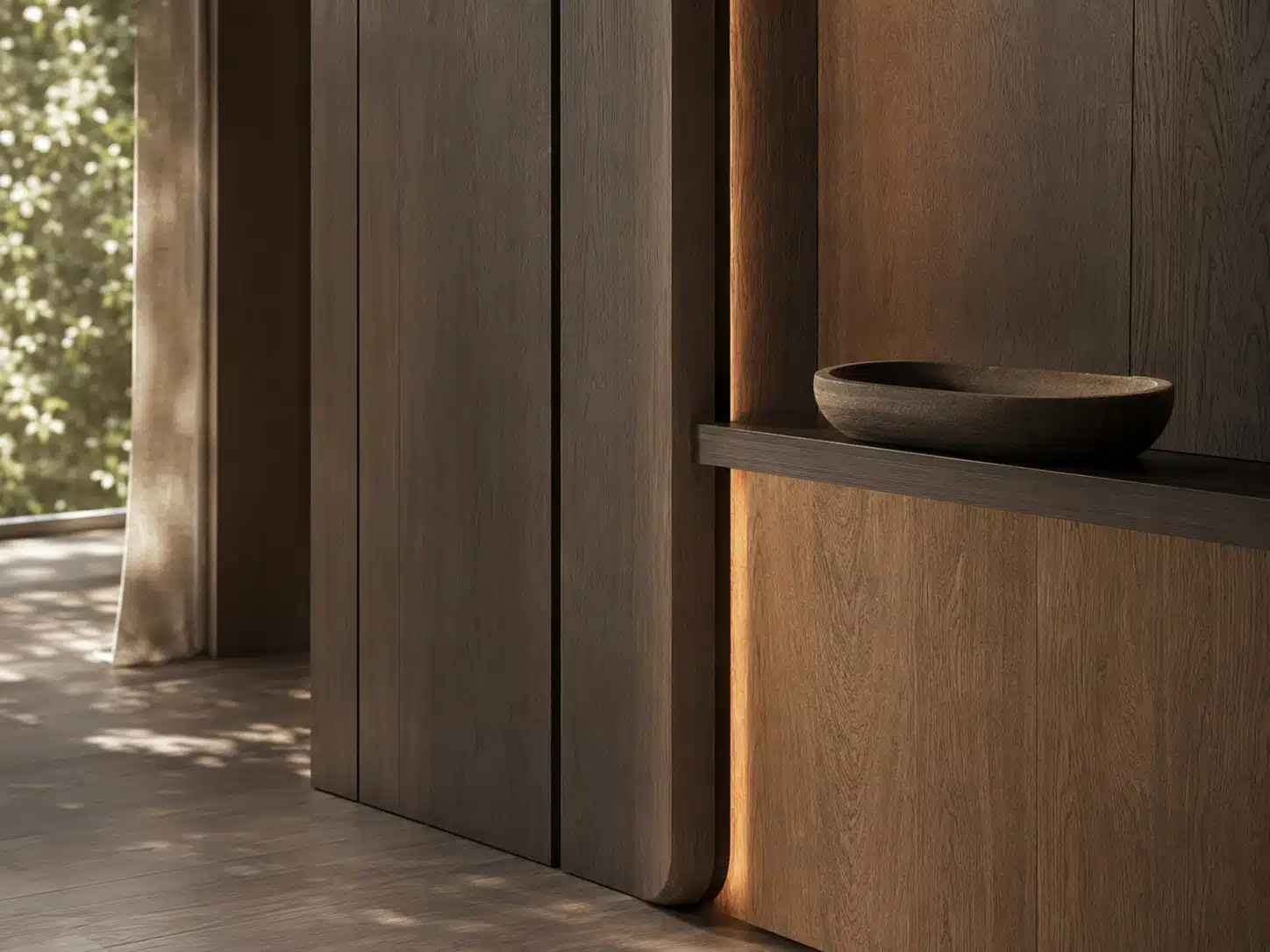
Wood in the interior creates rhythm.
Wood does not make a sleek interior any less architectural.
On the contrary: with the right grain direction, selection, and detailing, it can accentuate lines and refine large surfaces.
The appeal of wood lies in the combination of order and irregularity. The grain provides direction, while subtle color variations keep the surface alive. In bespoke work, the choice between solid wood, veneer, and composite board material determines not only the price but, above all, what is technically and aesthetically possible.
Veneer offers great control over the grain pattern and continuity. Techniques such as book-matching, slip-matching, or a calm, continuous grain allow a wall of cabinetry to be perceived as a single architectural plane. Solid wood is valuable for edges, handles, and parts subject to frequent handling; in these areas, the material’s weight and tactility can truly be felt.
Finishing significantly alters the character of the wood. Brushing opens the grain and adds depth. Smoking deepens the color, while oiling generally preserves a more natural look than a heavy lacquer coating. The right shade is not chosen in isolation but is coordinated with stone, metal, textiles, and the room’s lighting. A dark oak wall, for instance, can bring a sense of calm to a spacious living area, provided there are sufficient soft and mineral elements to balance it.
Detailing makes all the difference. Continuous grain across fronts, narrow shadow gaps, rounded corners, and carefully selected handles prevent custom cabinetry from looking like a mere collection of cupboards. It becomes architecture. This process involves full-scale mock-ups and samples: color, sheen, and texture must be evaluated on-site and under the actual lighting conditions.
In short
Design with the grain. Determine the selection, joint layout, orientation, edge detailing, and finish in advance.